1. The type of food I eat makes no difference whatsoever. Wheat bread is not better for my BG than white bread (it just tastes better).
2. Using the elliptical makes my BG go up for 4-5 hours three hours after I stop. It does lower it while I’m exercising, though. (this is the opposite of everything I have ever read on exercise).
3. The BG spike from two ounces of amaretto is negligible.
4. Orange juice used to treat a low wears off 20 minutes later and I’m low again. Whole milk works better.
5. Combo/extended boluses really work. I usually set mine for 50% now, 50% over the next half hour.
6. If I eat breakfast, my BG will go over 230. Always. If I take a lot of extra insulin, I will first go over 230, then go low. Skipping breakfast shows my basal is fine.
7. Stress does not seem to affect my BG at all. Or, my BG is so sensitive to stress that it is constantly affected by the stress of waking up, the stress of driving, the stress of working, the stress of not working….
8. The low BG alarm on the monitor is embarrassingly loud during the day, but will not wake me at night (possibly because by the time it thinks I’m below 100 I’m really below 50). It doesn’t wake my husband either.
9. The best week I have ever seen for BG was during Christmas, when I ate tons of baked goodies, drank lots of sweet booze, was under a lot of stress both at work and home, and did no exercise. Go figure.
10. Even having a continuous readout, doing ten or more fingersticks a day, and going over everything with my CDE once a week does not get me to an a1c of 7.0.
11. Some days, my BG numbers are just completely random. I have not yet tried seeing if there is a correlation to the Dow (Val’s BG went up after hearing news of the dollar’s weak showing against the yen). Don’t laugh, I’ve tried everything else.
12. I work backwards. I can pretty much read what is supposed to happen for the “typical” diabetic and know I’ll be the opposite. This includes exercising (higher not lower), junk food (spikes less than health food), menses (high for 2 weeks after, low the week before), and being sick (runs lower when I’m sick).
13. Decaf coffee raises my BG. A large decaf coffee with ½ cup milk I have to treat like 20g of carbs. Don’t ask my why, that’s just how it works.
14. Just because I can see my BG is high, doesn't mean I can do anything about it.
Tuesday, March 21, 2006

Sunday, February 19, 2006
Don't pull out that checkbook just yet
I haven’t been updating very often. I kept hoping the initial issues would be straightened out and I’d be able to tell you how wonderful the integrated pump and continuous BG monitor was. I knew it wouldn’t be perfect, but I had hoped it would at least be useful. I’m not so sure it is. Here’s my opinions, in bullet form:
What they got right
The display. One click on the pump and I see a graph of the previous 3 hours, plus my current BG reading, plus an indicator if things are changing “rapidly”: one arrow for rising/dropping a point a minute for the last 20, 2 arrows if two points a minute. This screen is probably the most useful thing about the whole setup.
The display part 2. There is a second screen which shows you the previous 24 hours, same extra info, which is really great when you wake up and want to see what the heck happened overnight, or is my bizarre overreaction to breakfast today as bad as it was yesterday, etc.
The software. As part of the study, you download the pump to a website, where you can create various reports of the data. My favorite is the one where you can overlay the past X days of sensor readings, to allow you to look for patterns. Sure, there are improvements that could be made to the interface for this, and more flexibility would be nice, but in general it’s a useful tool the way it is. Which brings us to –
What needs more work
Accuracy. It’s hard to decide where to start on this list, but I guess this is the biggest issue. I mean, we all know that the BG reading you see on your meter is pretty much an imaginary number. Try it twice in a row, or the same drop of blood and strips in your meter and back up meter, and you’ll see ten to fifteen points difference most of the time. Plus, sensor is measuring BG in interstitial fluid, not blood. So I know I shouldn’t be upset if the sensor and the meter disagree by 20 points or so. The problem is, they differ by much more than that an awful lot of the time. You pretty much have to ignore the first twelve hours or more, where I’ve seen the sensor and the meter as much as 100 points apart. (See warm-up time, below). But even when you’re on day 2 or 3 of the sensor, sometimes the readings are just out to lunch. Like 190 versus 286 as a post meal reading.
The BG meter. OK, this is a study thing, but maybe it’s contributing to the accuracy mentioned above. The deal is, all us study participants must use the same meter and strips. Makes sense, doesn’t it? Except, there’s a problem with the meter we’re using. It’s not great below 100. %$#@&! Hello? Below 100 is when you NEED the meter to be accurate. Here’s the deal. I tend not to feel a low until I’m about 55 or so. I’ve been working at avoiding them (I averaged one a day below 55 before the study started) and now only seem to get shaky every other day or so. But, when I check with the meter, I was seeing things like 94, or 78. Hmm, guess I was wrong. Well, then I get a call from our study coordinator saying that they think there is a problem with this meter in the normal-to-low range, so if you feel low, treat it anyway, or double-check on your old meter. So the next day I felt weird; the sensor showed me happily buzzing along at 110 or so, and I decided to do a comparison. Big drop of blood, half on old meter (fresh bottle of strips), half on the meter for the study, the one the sensor calibrates against. The result? Study meter says I’m 78. Old meter says 53. I feel 53. Making the sensor exactly DOUBLE my best guess as to my actual BG.
Sensitivity. I try to look at the picture more than the number. Hey, the numbers may be off, but at least it shows you whether you’re climbing or falling. Except when it doesn’t. Take this morning for instance. When I went to bed, sensor thought I was 156; meter said I was 136. No big deal – in the ballpark, if slightly lower than I like to be at bedtime. I decided to leave it alone and see how I did overnight. I woke up, and the display screen showed me relatively flat all night and currently 142. I checked with the meter and got 85. WTF? I dropped 51 points overnight, not 14. There’s a big difference there. To be fair, I realize this is a complex thing to measure, the sensor degrades as your body tries to “coat” the thing under your skin, which is why you have to keep re-calibrating it with the meter. BUT, as a consumer I’m just saying that I don’t like it.
Warm up time. You have to change the sensor every three days. I do it with my site change. After you put the sensor in, you tell the pump about it, and it goes into a countdown for 3 hours, and then beeps to ask you for its first calibration reading. About 15 minutes after the calibration your first reading shows up on the pump. So far, so good. The problem is, that it takes a lot longer than that to actually be accurate – or as accurate as it gets. Some times it seems ok in the afternoon after my morning site change, some times it’s not synched up until the following morning. Some times it never syncs up. Then, at 36 hours exactly, it beeps and shuts off. The reasoning (I assume) is, that it degrades over time (hah!) and they don’t want you using the meter values as gospel when they know it’s off. As opposed to the rest of the time, when the inaccurate values are apparently OK. It would be better if at 36 hours it gave you a warning (like a low reservoir warning) and then shut down in another 6 or so.
Quality control. The first box of sensors I got, half of them went bad. Most of those were during the warm-up period, before I ever got a reading from them. My study coordinator actually replaced the little transmitter too, in the thought that it might be that rather than the sensors going bad. Afterward, in the second box, I’ve only had one go bad. BUT, keep in mind in the real world, I’d be paying for these. Let’s assume these sensors sell for the same price Wil pays, about $40 a pop. I’m ignoring the cost of the transmitter and the pump itself here. That means I tossed about $200 without ever getting any benefit from them. Add to that the warm-up day, the accuracy problems, etc, and it comes out to about $40 a day when you actually get useful readings from them. Would I use it if my insurance paid for it? Yeah, in a heartbeat, because it’s at least better than what’s out there right now. Would I use it if I had to pay $15 a day on my own? Probably. We can afford that, if we’re careful. Would I use it as it stands now, where I average 1 day in 3 of useful information – $40 a day for the days that it works? No way in hell.
Transmitter. The transmitter which sends the readings to the pump is not small. It’s an oval shape, the length and thickness of my pinky. You stick it to your skin with an adhesive pad that starts to itch after about two days and leaves behind a sticky residue That you have to really scrub at it to get off. A lot of times, it doesn’t deal with the fact that while I’m sleeping the pump might be on the other side of my body. It beeps politely to let me know there’s a weak signal, which I sleep through, and eventually shuts off sensor communication. At this point the pump beeps again, and again, until it finally goes into beep and vibrate mode and wakes me up. I turn on the light, clear the alarm, and re-start the sensor, which means that in 15 minutes it beeps again wanting a calibration, so I can’t go back to sleep until that happens. Now on its own this wouldn’t be a big deal. In fact, if this was the only problem with the whole setup I wouldn’t even mention it, but it is an irritation. And the fact that it is this thing that wakes me up, rather than a low alarm when I’ve obviously gone low overnight, this just pisses me off. I’ve had to reset the low threshold to alarm if I dip below 100 to have a chance of catching it before the real BG hits 50. What I think the issue is here is that they are using the technology because it’s cool, not because it’s useful. Yes, it’s really cool that the sensor/transmitter broadcasts a (random) BG reading to the pump, and that the pump displays them for you. It’s great that you can do this without wires. BUT, what the developers seemed to have forgotten, is that we’re already hooked up to the frigging pump. Why not just run a wire along the infusion set tubing, with say 12-18 inches of free wire at the end so you can position the sensor away from your infusion site. That way, you’d definitely change it with your site, AND you wouldn’t have to worry about this lost sensor crap. Plus I wouldn’t find the damn thing alarming every time I step out of the shower, because it would KNOW I was disconnected.
OK, I’m not going to go into the minor annoyances at all, because if the major ones were fixed I could deal with the minor ones. My husband is amazed I’ve stuck with the study, but I want them to see what’s wrong, so they know what they should do before they make this a commercial product. I mean, it COULD be so damn good, if it only worked. In the meantime... Do you remember all the hype before Windows 95 came out? How great it looked, how much it did? And then when you actually used the real product, before the service packs came out? This is worse. This is Microsoft Bob (or the Paper Clip Guy, for those of you fortunate enought to have never seen Bob). It’s something that in theory could be really useful, even indispensable, but in reality it’s just a giant pain in the butt. I really hope they can get this to work – or someone else can – but I don’t think I’m going to be the first to jump on the boat to start throwing money at a 1.0 product.
What they got right
The display. One click on the pump and I see a graph of the previous 3 hours, plus my current BG reading, plus an indicator if things are changing “rapidly”: one arrow for rising/dropping a point a minute for the last 20, 2 arrows if two points a minute. This screen is probably the most useful thing about the whole setup.
The display part 2. There is a second screen which shows you the previous 24 hours, same extra info, which is really great when you wake up and want to see what the heck happened overnight, or is my bizarre overreaction to breakfast today as bad as it was yesterday, etc.
The software. As part of the study, you download the pump to a website, where you can create various reports of the data. My favorite is the one where you can overlay the past X days of sensor readings, to allow you to look for patterns. Sure, there are improvements that could be made to the interface for this, and more flexibility would be nice, but in general it’s a useful tool the way it is. Which brings us to –
What needs more work
Accuracy. It’s hard to decide where to start on this list, but I guess this is the biggest issue. I mean, we all know that the BG reading you see on your meter is pretty much an imaginary number. Try it twice in a row, or the same drop of blood and strips in your meter and back up meter, and you’ll see ten to fifteen points difference most of the time. Plus, sensor is measuring BG in interstitial fluid, not blood. So I know I shouldn’t be upset if the sensor and the meter disagree by 20 points or so. The problem is, they differ by much more than that an awful lot of the time. You pretty much have to ignore the first twelve hours or more, where I’ve seen the sensor and the meter as much as 100 points apart. (See warm-up time, below). But even when you’re on day 2 or 3 of the sensor, sometimes the readings are just out to lunch. Like 190 versus 286 as a post meal reading.
The BG meter. OK, this is a study thing, but maybe it’s contributing to the accuracy mentioned above. The deal is, all us study participants must use the same meter and strips. Makes sense, doesn’t it? Except, there’s a problem with the meter we’re using. It’s not great below 100. %$#@&! Hello? Below 100 is when you NEED the meter to be accurate. Here’s the deal. I tend not to feel a low until I’m about 55 or so. I’ve been working at avoiding them (I averaged one a day below 55 before the study started) and now only seem to get shaky every other day or so. But, when I check with the meter, I was seeing things like 94, or 78. Hmm, guess I was wrong. Well, then I get a call from our study coordinator saying that they think there is a problem with this meter in the normal-to-low range, so if you feel low, treat it anyway, or double-check on your old meter. So the next day I felt weird; the sensor showed me happily buzzing along at 110 or so, and I decided to do a comparison. Big drop of blood, half on old meter (fresh bottle of strips), half on the meter for the study, the one the sensor calibrates against. The result? Study meter says I’m 78. Old meter says 53. I feel 53. Making the sensor exactly DOUBLE my best guess as to my actual BG.
Sensitivity. I try to look at the picture more than the number. Hey, the numbers may be off, but at least it shows you whether you’re climbing or falling. Except when it doesn’t. Take this morning for instance. When I went to bed, sensor thought I was 156; meter said I was 136. No big deal – in the ballpark, if slightly lower than I like to be at bedtime. I decided to leave it alone and see how I did overnight. I woke up, and the display screen showed me relatively flat all night and currently 142. I checked with the meter and got 85. WTF? I dropped 51 points overnight, not 14. There’s a big difference there. To be fair, I realize this is a complex thing to measure, the sensor degrades as your body tries to “coat” the thing under your skin, which is why you have to keep re-calibrating it with the meter. BUT, as a consumer I’m just saying that I don’t like it.
Warm up time. You have to change the sensor every three days. I do it with my site change. After you put the sensor in, you tell the pump about it, and it goes into a countdown for 3 hours, and then beeps to ask you for its first calibration reading. About 15 minutes after the calibration your first reading shows up on the pump. So far, so good. The problem is, that it takes a lot longer than that to actually be accurate – or as accurate as it gets. Some times it seems ok in the afternoon after my morning site change, some times it’s not synched up until the following morning. Some times it never syncs up. Then, at 36 hours exactly, it beeps and shuts off. The reasoning (I assume) is, that it degrades over time (hah!) and they don’t want you using the meter values as gospel when they know it’s off. As opposed to the rest of the time, when the inaccurate values are apparently OK. It would be better if at 36 hours it gave you a warning (like a low reservoir warning) and then shut down in another 6 or so.
Quality control. The first box of sensors I got, half of them went bad. Most of those were during the warm-up period, before I ever got a reading from them. My study coordinator actually replaced the little transmitter too, in the thought that it might be that rather than the sensors going bad. Afterward, in the second box, I’ve only had one go bad. BUT, keep in mind in the real world, I’d be paying for these. Let’s assume these sensors sell for the same price Wil pays, about $40 a pop. I’m ignoring the cost of the transmitter and the pump itself here. That means I tossed about $200 without ever getting any benefit from them. Add to that the warm-up day, the accuracy problems, etc, and it comes out to about $40 a day when you actually get useful readings from them. Would I use it if my insurance paid for it? Yeah, in a heartbeat, because it’s at least better than what’s out there right now. Would I use it if I had to pay $15 a day on my own? Probably. We can afford that, if we’re careful. Would I use it as it stands now, where I average 1 day in 3 of useful information – $40 a day for the days that it works? No way in hell.
Transmitter. The transmitter which sends the readings to the pump is not small. It’s an oval shape, the length and thickness of my pinky. You stick it to your skin with an adhesive pad that starts to itch after about two days and leaves behind a sticky residue That you have to really scrub at it to get off. A lot of times, it doesn’t deal with the fact that while I’m sleeping the pump might be on the other side of my body. It beeps politely to let me know there’s a weak signal, which I sleep through, and eventually shuts off sensor communication. At this point the pump beeps again, and again, until it finally goes into beep and vibrate mode and wakes me up. I turn on the light, clear the alarm, and re-start the sensor, which means that in 15 minutes it beeps again wanting a calibration, so I can’t go back to sleep until that happens. Now on its own this wouldn’t be a big deal. In fact, if this was the only problem with the whole setup I wouldn’t even mention it, but it is an irritation. And the fact that it is this thing that wakes me up, rather than a low alarm when I’ve obviously gone low overnight, this just pisses me off. I’ve had to reset the low threshold to alarm if I dip below 100 to have a chance of catching it before the real BG hits 50. What I think the issue is here is that they are using the technology because it’s cool, not because it’s useful. Yes, it’s really cool that the sensor/transmitter broadcasts a (random) BG reading to the pump, and that the pump displays them for you. It’s great that you can do this without wires. BUT, what the developers seemed to have forgotten, is that we’re already hooked up to the frigging pump. Why not just run a wire along the infusion set tubing, with say 12-18 inches of free wire at the end so you can position the sensor away from your infusion site. That way, you’d definitely change it with your site, AND you wouldn’t have to worry about this lost sensor crap. Plus I wouldn’t find the damn thing alarming every time I step out of the shower, because it would KNOW I was disconnected.
OK, I’m not going to go into the minor annoyances at all, because if the major ones were fixed I could deal with the minor ones. My husband is amazed I’ve stuck with the study, but I want them to see what’s wrong, so they know what they should do before they make this a commercial product. I mean, it COULD be so damn good, if it only worked. In the meantime... Do you remember all the hype before Windows 95 came out? How great it looked, how much it did? And then when you actually used the real product, before the service packs came out? This is worse. This is Microsoft Bob (or the Paper Clip Guy, for those of you fortunate enought to have never seen Bob). It’s something that in theory could be really useful, even indispensable, but in reality it’s just a giant pain in the butt. I really hope they can get this to work – or someone else can – but I don’t think I’m going to be the first to jump on the boat to start throwing money at a 1.0 product.
Wednesday, December 28, 2005
My early Christmas present
OK, sorry it's taken a bit for me to update this, but Christmas time is somewhat crazy here. But crazy in a good way. I had my parents and four of my five siblings with their families over for dinner. This year, that was 26 people -- a small crowd, last Christmas was 34. I think we scared off my husband's tiny family this year. And no, I don't do it all myself - we all bring something (Mom made the turkey/stuffing/gravy) so my job was to clean the house, buy beverages and make mashed potatoes. Everything went really smoothly and I had a great time. It was great to see my 3 boys and 6 boy cousins all piled on the couch playing/watching Lego Star Wars on the Xbox. And the best of all was that, even with gingerbread men for breakfast, wine, brandy alexanders, potatoes, stuffing, cookies, two kinds of cheesecake, trifle, etc, etc, etc that I ate, my BG stayed between 80 and 140 80% of day, and peaked at 216 for just a short time! Of course, Monday I was back to being mostly healthy and that's when I spent like half the day out of range. Oh, well.
I know some of you have been looking for an update on the integrated continous monitor & pump setup. I can't really provide identifying info without pissing off the study people (whom I really want to stay on the good side of - I don't want to have to give this gadget up), and I don't think I'm up to the detail and elegance provided by Wil in LifeAfterDx, so I'll just highlight a few things different from Wil's experiences and include my own observations.
Basically, it works a lot like the Guardian described by Wil, with the exception that you don't need to carry a separate receiver with you. You put the sensor under the skin and tape the transmitter nearby, then the pump picks up the readings. It has 2 status pages, one a graph of the last 3 hours, one the last 24 hours. Both graphs let you scroll the cursor back to see the numbers, and have little tick marks to indicate when you've bolused. I've had the sensor remain in contact while I'm in the shower and the pump is left next to the sink, but I've also had it lose contact twice when I'm in bed with the pump on one side and the sensor on the other (it beeps and I set the pump right against the transmitter for a few minutes and then it's happy again).
Based on what I've seen from the CGMS I wore last year, the week I wore one recently and random testing when the kids/dog wake me up at night, I sleep through a low (50 or below) an average of twice a week. I think this is a big contributor to my lack of "patterns" - my body remains in a permanent state of panic, making it tough to get any set of basals that really seem to work. Two days after I got this pump, it woke me at 2am to warn I was dropping low and I tested and was 56. (the sensor thought I was 78 but I guess it's the thought that counts). It does take a while to get synched up with the fingersticks -- as synched as it's going to get. I've had one day where they stayed within 10 points and another where I got readings 35-90 points off. I also had a sensor go bad on me -- while I was on the phone to my CDE. I just told her what the alarm said and she said I'd have to put in a new sensor. Since I was at work I waited until suppertime to set up the new one, now I'd rather have my next change be a morning thing but of course I'm leery of going a night without it, since that is when it really pays off.
I guess what I'm saying is its still not perfect, but it's a heck of a lot better than whatever else is out there at the moment. I tend not to feel a low until I'm below 60, so it's real handy to just look at the pump and see whether I'm headed upward or downward, even if I still need the fingerstick to confirm what's going on. I made a lot of use of this on Christmas, double-checking to see if my guesstimates were anything close to what I needed. This was perhaps the most useful thing about it, one click on the pump and I can see that I had been climbing, but have now leveled off and started to drop. I see Wil has started to make use of this as well, in his Light Bulb Moment post. Proactive BG treatment - the wave of the future!
I know some of you have been looking for an update on the integrated continous monitor & pump setup. I can't really provide identifying info without pissing off the study people (whom I really want to stay on the good side of - I don't want to have to give this gadget up), and I don't think I'm up to the detail and elegance provided by Wil in LifeAfterDx, so I'll just highlight a few things different from Wil's experiences and include my own observations.
Basically, it works a lot like the Guardian described by Wil, with the exception that you don't need to carry a separate receiver with you. You put the sensor under the skin and tape the transmitter nearby, then the pump picks up the readings. It has 2 status pages, one a graph of the last 3 hours, one the last 24 hours. Both graphs let you scroll the cursor back to see the numbers, and have little tick marks to indicate when you've bolused. I've had the sensor remain in contact while I'm in the shower and the pump is left next to the sink, but I've also had it lose contact twice when I'm in bed with the pump on one side and the sensor on the other (it beeps and I set the pump right against the transmitter for a few minutes and then it's happy again).
Based on what I've seen from the CGMS I wore last year, the week I wore one recently and random testing when the kids/dog wake me up at night, I sleep through a low (50 or below) an average of twice a week. I think this is a big contributor to my lack of "patterns" - my body remains in a permanent state of panic, making it tough to get any set of basals that really seem to work. Two days after I got this pump, it woke me at 2am to warn I was dropping low and I tested and was 56. (the sensor thought I was 78 but I guess it's the thought that counts). It does take a while to get synched up with the fingersticks -- as synched as it's going to get. I've had one day where they stayed within 10 points and another where I got readings 35-90 points off. I also had a sensor go bad on me -- while I was on the phone to my CDE. I just told her what the alarm said and she said I'd have to put in a new sensor. Since I was at work I waited until suppertime to set up the new one, now I'd rather have my next change be a morning thing but of course I'm leery of going a night without it, since that is when it really pays off.
I guess what I'm saying is its still not perfect, but it's a heck of a lot better than whatever else is out there at the moment. I tend not to feel a low until I'm below 60, so it's real handy to just look at the pump and see whether I'm headed upward or downward, even if I still need the fingerstick to confirm what's going on. I made a lot of use of this on Christmas, double-checking to see if my guesstimates were anything close to what I needed. This was perhaps the most useful thing about it, one click on the pump and I can see that I had been climbing, but have now leveled off and started to drop. I see Wil has started to make use of this as well, in his Light Bulb Moment post. Proactive BG treatment - the wave of the future!
Monday, December 19, 2005
Name that stress
The other day my five year old said to me, "Mommy, I don't remember what you looked like before you got your pump." I ignored his older brother ("the same as she does now, only without a pump, stupid!") and said "Sometimes I don't either". Because he had just turned four when I started taking insulin; was four and a half when I got the pump. So he really doesn't remember a time when Mommy wasn't all stressed out with this disease; when I wasn't sticking my fingers ten times a day, when every third morning I wasn't busy with a site change and snapping "ask Daddy to get you breakfast". I can't say he doesn't remember a Mommy who wasn't cranky if she missed a meal, because that has pretty much always been true ; )
On the other hand, life wasn't exactly stress-free before. When my oldest son was five, I was working a ton of extra hours at work with a toddler and a baby on the way; when the middle guy was five, I was agonizing over a job change, building a new house with an old one that wouldn't sell, and so on. So I recognize that even if this is a huge new deal to me, to the kids it's just another in a long line of grownup issues. And I just have to deal with it, because that's the only real option.
His comment did bother me, but I need to look at the fact that most of the time this disease is really nothing more to me then a big pain in the butt (literally!). And sometimes, it's a source of humor. I mean, I'm getting ready for my end-of-study-control-period by wearing a CGMS again for a solid week. It would, of course, have to be the week of my company Xmas party, where my BG was way up there pretty much all day as I pigged out. Lord knows what the graph for that is going to look like ("When good diabetics go bad"). And I had a pretty amusing time trying to come up with a way to hide both a pump and a monitor beneath a slinky evening dress without looking like some kind of holiday suicide bomber. Note to self: clipping both devices to a single garter wasn't the best idea - the combined weight kept trying to pull down the garter, which was clipped to my underwear, which wasn't clipped to anything... Luckily a few timely trips to the ladies' room averted any real catastrophe.
And then there was yesterday's conversation with my husband:
me - You got a box from Amazon.
him - Don't open it; that's your Christmas present. It's something you really want.
me - I don't think they sell pancreases on amazon. Though I imagine you could try on eBay.
him - That box would be in the fridge.
Actually, my real present comes tomorrow, when I start my non-control group six months of integrated-pump-and-continuous-monitor study. Stay tuned for details...
On the other hand, life wasn't exactly stress-free before. When my oldest son was five, I was working a ton of extra hours at work with a toddler and a baby on the way; when the middle guy was five, I was agonizing over a job change, building a new house with an old one that wouldn't sell, and so on. So I recognize that even if this is a huge new deal to me, to the kids it's just another in a long line of grownup issues. And I just have to deal with it, because that's the only real option.
His comment did bother me, but I need to look at the fact that most of the time this disease is really nothing more to me then a big pain in the butt (literally!). And sometimes, it's a source of humor. I mean, I'm getting ready for my end-of-study-control-period by wearing a CGMS again for a solid week. It would, of course, have to be the week of my company Xmas party, where my BG was way up there pretty much all day as I pigged out. Lord knows what the graph for that is going to look like ("When good diabetics go bad"). And I had a pretty amusing time trying to come up with a way to hide both a pump and a monitor beneath a slinky evening dress without looking like some kind of holiday suicide bomber. Note to self: clipping both devices to a single garter wasn't the best idea - the combined weight kept trying to pull down the garter, which was clipped to my underwear, which wasn't clipped to anything... Luckily a few timely trips to the ladies' room averted any real catastrophe.
And then there was yesterday's conversation with my husband:
me - You got a box from Amazon.
him - Don't open it; that's your Christmas present. It's something you really want.
me - I don't think they sell pancreases on amazon. Though I imagine you could try on eBay.
him - That box would be in the fridge.
Actually, my real present comes tomorrow, when I start my non-control group six months of integrated-pump-and-continuous-monitor study. Stay tuned for details...
Monday, November 21, 2005
Oh, the technology!
OK, I’ll try and keep this rant a bit shorter, in the hopes of actually being able to post more often. I’ve actually been doing pretty good, BG-wise, for the past few weeks. Except for waking up at about 60 in the morning, which I’m afraid to play with since everything else has been going so well.
Which leads into my rant, which is about the level of technology available for use by people with diabetes. Don’t get me wrong. I love having a pump, and I’m really glad I didn’t get this disease until after the availability of home BG testers (not to mention really REALLY glad that it was after the discovery of insulin, unlike one of my great-grandfathers, who died in the early nineteen-twenties a few months after being diagnosed - wonder which type he was). But, the technology just isn’t quite "there" yet.
For example, why isn’t there some way of telling if your bottle of insulin has gone bad, other than injecting it and waiting to see what happens?
I tend to be both incredibly sensitive to insulin and to carbohydrates. This is wearing off a bit as my honeymoon ends, but last February I had a correction factor of 1 unit for 80 points and BG readings that were just all over the place. So my doctor suggested I wear the 72-hour continuous glucose monitor to see if we can get a picture of what the heck was going on. Wow, that will really be useful, I thought. Until I found out that I don’t get to see the numbers. And that the piece of equipment you had to wear looked like a Radio Shack remote control from the 1970s. And that the thick rubber cable didn’t detach when you took a shower, so you had to wear it in a baggie around your neck in the shower. I suddenly knew how a cat feels when it has to wear one of those plastic Elizabethan collars. If I had cat ears, they’d be flat back against my skull. Mad, and humiliated. And wet.
My CDE explained to me how to enter in all my carbs, exercise, and readings (and I’m not even going to go into to user interface design here). She also mentioned that it won’t pick up readings below 45 or so.
"But will it beep or something if it gets that low, to warn you?" Well, no. That would be the next generation. Lovely.
Anyway, I wore the thing and dutifully entered everything I could think of. I even ate the same breakfast and lunch every day, and have virtually the same dinner, too, to eliminate as many of the extra variables as I could (two or three out of dozens, doesn’t really help, but made me feel more in control ; )
My fingersticks were my typical 60-220 or so. I had one reasonable day and a couple of bouncy days. Then I turn in the monitor and get a copy of my readouts in the mail.
Whoa! Turns out one night, where I’d gone to bed at about 160 and woke at 70, I had really nose-dived immediately after falling asleep, hit "too low to read" by 1 am, and despite my body trying three times to push my BG back over 70, it didn’t happen until I woke up and had breakfast. I was psyched about the 70, but then ate the same breakfast as the day before and this time went over 220 with it. I had two lows around 50 late that afternoon too.
So what would happen, I keep asking myself, if my liver didn’t kick in at 2am and try to dump in some sugar? For that matter, what did happen, between 1 and 2 that night? I don’t know, I was asleep. And just how often does it do that, anyway?
For months I tried setting alarms at random points during the night, only to discover the diabetic’s equivalent of the Heisenberg uncertainty principle: you can see what your BG is, or you can sleep, but waking up enough to measure it basically stops what you’re trying to measure in the first place, and shifted my predictable late-afternoon low to random times throughout the day.
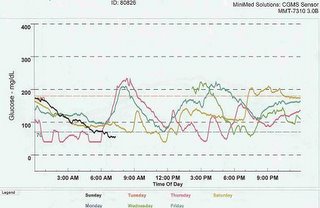
Here’s a shot of the CGMS readings, each day a different color. Keep in mind this was with food and exercise levels as close to identical as I could make them.
So after months of pestering my CDE that there has got to be something better out there, I find out about the study. It’s for an integrated pump and continuous monitor. You wear a sensor that’s inserted like an infusion set, (and then taped in place) and it broadcasts readings to the pump, giving you a continual readout. Great! There’s a six month study period, followed by a six month extension, where both the sensor and control groups get to use the sensor. I am so psyched about this, this may be my only way of tracking down my incredible bouncing BG to some sort of reasonable a1c value.
So I go for the preliminary screenings, wear the klunky old CGMS around for a week (can’t see those readings until the end of the year), and finally get enrolled – in the control group. Man, that was disappointing. So for the past five months, I’ve been using a pump and monitor for the study that I like less than my Animas 1200 and UltraSmart, and uploading my values a few times a week, plus talking to the dr’s once a week or so and tweaking my basal settings. It took four months of guesswork for my readings to get to something approaching the level of control I’d be happy with, and of course I’m amazed it’s stayed okay for even these last few weeks. It’s so frustrating to know with a sensor I could probably straighten things out within a week or so.
But, I’m trying to look on the bright side. Right now, what I’m thinking is that I have documented evidence of six months of intensive work between me, my doctor, and my CDE, resulting in an average a1c over this time of: 8.0. Really, eight point frigging oh! How on earth can I put this much time into something and not see some better results! Oh, yeah, bright side, bright side.... Well, what I’m thinking is, when I also have six months of documentation on what my BG is with the sensor, I’ll have a very good argument for my insurance company that I need this device! And that paying for the sensor might be cheaper than paying for me to have a weekly appt with the doctor, not to mention the complications that I’m trying like mad to avoid...
So anyway, that’s where I’m at now. So much for the shorter post - it’s just that when I’m pissed ("motivated") enough to write, I tend to just dump it all out. Stay tuned for a report on the sensor, which I get to use just in time for Christmas ("Hey, watch me eat this brownie!")
Have a happy turkey day, all!
Val
PS - yes, it’s OK for any members of the "OC" out there to link to my site - drop me an email if you do. And I do plan on fixing the ugly colors on here at some point....

Which leads into my rant, which is about the level of technology available for use by people with diabetes. Don’t get me wrong. I love having a pump, and I’m really glad I didn’t get this disease until after the availability of home BG testers (not to mention really REALLY glad that it was after the discovery of insulin, unlike one of my great-grandfathers, who died in the early nineteen-twenties a few months after being diagnosed - wonder which type he was). But, the technology just isn’t quite "there" yet.
For example, why isn’t there some way of telling if your bottle of insulin has gone bad, other than injecting it and waiting to see what happens?
I tend to be both incredibly sensitive to insulin and to carbohydrates. This is wearing off a bit as my honeymoon ends, but last February I had a correction factor of 1 unit for 80 points and BG readings that were just all over the place. So my doctor suggested I wear the 72-hour continuous glucose monitor to see if we can get a picture of what the heck was going on. Wow, that will really be useful, I thought. Until I found out that I don’t get to see the numbers. And that the piece of equipment you had to wear looked like a Radio Shack remote control from the 1970s. And that the thick rubber cable didn’t detach when you took a shower, so you had to wear it in a baggie around your neck in the shower. I suddenly knew how a cat feels when it has to wear one of those plastic Elizabethan collars. If I had cat ears, they’d be flat back against my skull. Mad, and humiliated. And wet.
My CDE explained to me how to enter in all my carbs, exercise, and readings (and I’m not even going to go into to user interface design here). She also mentioned that it won’t pick up readings below 45 or so.
"But will it beep or something if it gets that low, to warn you?" Well, no. That would be the next generation. Lovely.
Anyway, I wore the thing and dutifully entered everything I could think of. I even ate the same breakfast and lunch every day, and have virtually the same dinner, too, to eliminate as many of the extra variables as I could (two or three out of dozens, doesn’t really help, but made me feel more in control ; )
My fingersticks were my typical 60-220 or so. I had one reasonable day and a couple of bouncy days. Then I turn in the monitor and get a copy of my readouts in the mail.
Whoa! Turns out one night, where I’d gone to bed at about 160 and woke at 70, I had really nose-dived immediately after falling asleep, hit "too low to read" by 1 am, and despite my body trying three times to push my BG back over 70, it didn’t happen until I woke up and had breakfast. I was psyched about the 70, but then ate the same breakfast as the day before and this time went over 220 with it. I had two lows around 50 late that afternoon too.
So what would happen, I keep asking myself, if my liver didn’t kick in at 2am and try to dump in some sugar? For that matter, what did happen, between 1 and 2 that night? I don’t know, I was asleep. And just how often does it do that, anyway?
For months I tried setting alarms at random points during the night, only to discover the diabetic’s equivalent of the Heisenberg uncertainty principle: you can see what your BG is, or you can sleep, but waking up enough to measure it basically stops what you’re trying to measure in the first place, and shifted my predictable late-afternoon low to random times throughout the day.
Here’s a shot of the CGMS readings, each day a different color. Keep in mind this was with food and exercise levels as close to identical as I could make them.
So after months of pestering my CDE that there has got to be something better out there, I find out about the study. It’s for an integrated pump and continuous monitor. You wear a sensor that’s inserted like an infusion set, (and then taped in place) and it broadcasts readings to the pump, giving you a continual readout. Great! There’s a six month study period, followed by a six month extension, where both the sensor and control groups get to use the sensor. I am so psyched about this, this may be my only way of tracking down my incredible bouncing BG to some sort of reasonable a1c value.
So I go for the preliminary screenings, wear the klunky old CGMS around for a week (can’t see those readings until the end of the year), and finally get enrolled – in the control group. Man, that was disappointing. So for the past five months, I’ve been using a pump and monitor for the study that I like less than my Animas 1200 and UltraSmart, and uploading my values a few times a week, plus talking to the dr’s once a week or so and tweaking my basal settings. It took four months of guesswork for my readings to get to something approaching the level of control I’d be happy with, and of course I’m amazed it’s stayed okay for even these last few weeks. It’s so frustrating to know with a sensor I could probably straighten things out within a week or so.
But, I’m trying to look on the bright side. Right now, what I’m thinking is that I have documented evidence of six months of intensive work between me, my doctor, and my CDE, resulting in an average a1c over this time of: 8.0. Really, eight point frigging oh! How on earth can I put this much time into something and not see some better results! Oh, yeah, bright side, bright side.... Well, what I’m thinking is, when I also have six months of documentation on what my BG is with the sensor, I’ll have a very good argument for my insurance company that I need this device! And that paying for the sensor might be cheaper than paying for me to have a weekly appt with the doctor, not to mention the complications that I’m trying like mad to avoid...
So anyway, that’s where I’m at now. So much for the shorter post - it’s just that when I’m pissed ("motivated") enough to write, I tend to just dump it all out. Stay tuned for a report on the sensor, which I get to use just in time for Christmas ("Hey, watch me eat this brownie!")
Have a happy turkey day, all!
Val
PS - yes, it’s OK for any members of the "OC" out there to link to my site - drop me an email if you do. And I do plan on fixing the ugly colors on here at some point....
Sunday, November 06, 2005
My Diagnosis
I’ve read many stories talking about how people were first diagnosed with type 1 diabetes after an illness - in fact, I’ve read claims that there "must" be a viral infection to set it off. Which isn’t me. I honestly don’t think I had so much as a cold for at least six months before diagnosis, and I hadn’t taken a sick day for me (as opposed to the kids) in two years. To be truthful, everything at home had been going so smoothly, I was getting a bit superstitious about it. We were past due to get hit with something. Big. And we were. How I was diagnosed with this serious, all-consuming, pain-in-the-ass disease was: I went for a physical.
Looking back, there had been a few symptoms: my eyesight had seemed a bit blurry for a while. But I was almost 37, had been working on computers 10-12 hours a day for 20 years. I figured maybe I finally needed glasses. And I was going to the bathroom more often, even if it seemed like just a tiny amount was coming out. I would go just before I left work, and by the time I’d picked up the kids and gotten home an hour later, I would have to charge into the bathroom again. I figured it was a urinary tract infection, but I had a dr’s appt less than a week away, so I wasn’t worried.
I was drinking a bit more than usual too, but nothing drastic. Certainly not anything out of line with what everyone else was doing with the dry office building heat. The one time I was really thirsty, two days before my physical, was when I’d been at saber fencing lessons with my then-eight-year old. We’d had a real workout in too-warm sweatpants, were dripping with sweat in December, and on the way home we got an ice cream cone as a reward. I got home and drank three glasses of water - very unusual for me - but the next day I was fine.
So I wasn’t really expecting it when instead of the nurse coming in for the usual stuff at the start of the checkup, my doctor comes in instead. He says my fasting urine sample had sugar in it, and they wanted to double-check with a finger-stick and then maybe draw some blood. The finger-stick showed 232. My doctor (I’ll call him Dr A for this piece) asked if anyone in my family had diabetes. Well, my grandmother had it since her sixties. And my dad was diagnosed about a year ago, in his early seventies. Both had done fine with just diet control, which I had vaguely assumed meant cutting down on sweets.
Dr A seemed very surprised that someone my age and build (5 foot 6, 128 lbs) would get diabetes. He wrote out a prescription for a meter and told me over the next two weeks to check once a day: sometimes when I woke up, sometimes two hours after a meal. He said to cut down on my carb intake - rice, pasta, potatoes, sugar, bread, etc. "You mean like Atkins?" I asked. Atkins was pretty much at its peak then. "Yes, like that. Eat less, exercise more, and call me if it goes over 350."
The only thing I had presence of mind enough to ask was "this can only mean diabetes, right? It can’t be anything worse?" Boy, was I naive.
I got a bunch of type 2 diabetes pamphlets in a bag. Welcome to the club.
I went home, somehow managing not to blurt out my bad news or start crying until after the kids were in bed. I did another finger-stick. 283.
My husband probably saved my life by going off to amazon and rush-ordering me a book. The First Year: Type 2 Diabetes. I read it through twice in one day. Dr A called to tell me the lab test came back with an a1c of 9.2. Definitely diabetes. "But what about type 1?" I asked. The book talked about how many thin type 2's were actually type 1. Well, that wasn’t too likely, Dr A said, given that I had a family history of type 2 (???) And anyway, it wouldn’t be treated any differently as long as things were working.
So I went thru Christmas and new years on an ultra-low carb diet. It seemed to work, at first. I had fasting readings in the 80s in January. Then Feb came, and kicked off a month of pure hell.
To start off with, I got a sinus infection, and my bg readings were back in the 290s. I was also running a temperature of around 101 all the time. I went in, got antibiotics, and the sinus infection went away. The temperature didn’t. I could not get a temperature reading below 100 degrees for 22 days. I bought 2 different thermometers, made my husband take both our temps in case there was something wrong with my technique. Dr A checked for a urinary tract infection - nothing. He did blood work, looking for other weird viruses. All negative. My BG readings remained high. He told me to eat less and exercise more. At this point I was down to 24 g of carbohydrate a day and 90 minutes on an elliptical after supper every night. It didn’t help.
The blood tests started getting more esoteric, and more scary. We even did a C-T scan, looking for tumors. I kept asking "Could this be connected to the diabetes?" and kept being told no. I complained that I ate virtually no carbs and my blood sugar still went up 100 points when I ate. Dr A said I was testing too often. Once a day was plenty for type 2. I responded I wouldn’t test more often if every time I tested I saw values between say 100 and 130, but I was seeing things like 187 - 316 - 248 - 325 - 192....
I stopped going back to the doctor’s about the temperature, figuring he was out of ideas anyway. In March I went back to Dr A and asked him to run tests for anti-GAD, anti-insulin, and anti-ICA. He’d never heard of them, but agreed to have them done.
I got a phone call from a nurse about the results. Dr A was not available, but in the background I heard his partner complaining "Who ordered these tests? We never order these tests. I don’t even know what they’re for." The lab had never ran the anti insulin one. The anti-GAD lab normal range was from 0.0 to 0.1 and I had 128.2. Anti-ICA was usually negative and I had 38. "Um, what do these test mean?" The nurse asked. "They mean I want a referral to an endocrinologist and I no longer wish to be seen by this practice." I did phone Dr A later and politely informed him that it was indeed type one diabetes, and should he ever see another patient with similar symptoms, please keep that in mind and not put them through four months of guesswork.
Enter Dr B. I was probably the first patient he ever had who was relieved to be told they needed insulin. At this point I weighed 111 lbs and since I am 5'6, looked like a poster child for eating
disorders. Or in my case, not-eating disorders. We phased in insulin using MDI and gradually phased in the food as well. But what really pissed me off about the whole runaround was that two seconds after Dr B first walked into the room, he touched my forehead and said, "You seem to be running a temperature. That is very common in autoimmune disorders." So much for all the expensive testing over the whole month of February.
Looking back, there had been a few symptoms: my eyesight had seemed a bit blurry for a while. But I was almost 37, had been working on computers 10-12 hours a day for 20 years. I figured maybe I finally needed glasses. And I was going to the bathroom more often, even if it seemed like just a tiny amount was coming out. I would go just before I left work, and by the time I’d picked up the kids and gotten home an hour later, I would have to charge into the bathroom again. I figured it was a urinary tract infection, but I had a dr’s appt less than a week away, so I wasn’t worried.
I was drinking a bit more than usual too, but nothing drastic. Certainly not anything out of line with what everyone else was doing with the dry office building heat. The one time I was really thirsty, two days before my physical, was when I’d been at saber fencing lessons with my then-eight-year old. We’d had a real workout in too-warm sweatpants, were dripping with sweat in December, and on the way home we got an ice cream cone as a reward. I got home and drank three glasses of water - very unusual for me - but the next day I was fine.
So I wasn’t really expecting it when instead of the nurse coming in for the usual stuff at the start of the checkup, my doctor comes in instead. He says my fasting urine sample had sugar in it, and they wanted to double-check with a finger-stick and then maybe draw some blood. The finger-stick showed 232. My doctor (I’ll call him Dr A for this piece) asked if anyone in my family had diabetes. Well, my grandmother had it since her sixties. And my dad was diagnosed about a year ago, in his early seventies. Both had done fine with just diet control, which I had vaguely assumed meant cutting down on sweets.
Dr A seemed very surprised that someone my age and build (5 foot 6, 128 lbs) would get diabetes. He wrote out a prescription for a meter and told me over the next two weeks to check once a day: sometimes when I woke up, sometimes two hours after a meal. He said to cut down on my carb intake - rice, pasta, potatoes, sugar, bread, etc. "You mean like Atkins?" I asked. Atkins was pretty much at its peak then. "Yes, like that. Eat less, exercise more, and call me if it goes over 350."
The only thing I had presence of mind enough to ask was "this can only mean diabetes, right? It can’t be anything worse?" Boy, was I naive.
I got a bunch of type 2 diabetes pamphlets in a bag. Welcome to the club.
I went home, somehow managing not to blurt out my bad news or start crying until after the kids were in bed. I did another finger-stick. 283.
My husband probably saved my life by going off to amazon and rush-ordering me a book. The First Year: Type 2 Diabetes. I read it through twice in one day. Dr A called to tell me the lab test came back with an a1c of 9.2. Definitely diabetes. "But what about type 1?" I asked. The book talked about how many thin type 2's were actually type 1. Well, that wasn’t too likely, Dr A said, given that I had a family history of type 2 (???) And anyway, it wouldn’t be treated any differently as long as things were working.
So I went thru Christmas and new years on an ultra-low carb diet. It seemed to work, at first. I had fasting readings in the 80s in January. Then Feb came, and kicked off a month of pure hell.
To start off with, I got a sinus infection, and my bg readings were back in the 290s. I was also running a temperature of around 101 all the time. I went in, got antibiotics, and the sinus infection went away. The temperature didn’t. I could not get a temperature reading below 100 degrees for 22 days. I bought 2 different thermometers, made my husband take both our temps in case there was something wrong with my technique. Dr A checked for a urinary tract infection - nothing. He did blood work, looking for other weird viruses. All negative. My BG readings remained high. He told me to eat less and exercise more. At this point I was down to 24 g of carbohydrate a day and 90 minutes on an elliptical after supper every night. It didn’t help.
The blood tests started getting more esoteric, and more scary. We even did a C-T scan, looking for tumors. I kept asking "Could this be connected to the diabetes?" and kept being told no. I complained that I ate virtually no carbs and my blood sugar still went up 100 points when I ate. Dr A said I was testing too often. Once a day was plenty for type 2. I responded I wouldn’t test more often if every time I tested I saw values between say 100 and 130, but I was seeing things like 187 - 316 - 248 - 325 - 192....
I stopped going back to the doctor’s about the temperature, figuring he was out of ideas anyway. In March I went back to Dr A and asked him to run tests for anti-GAD, anti-insulin, and anti-ICA. He’d never heard of them, but agreed to have them done.
I got a phone call from a nurse about the results. Dr A was not available, but in the background I heard his partner complaining "Who ordered these tests? We never order these tests. I don’t even know what they’re for." The lab had never ran the anti insulin one. The anti-GAD lab normal range was from 0.0 to 0.1 and I had 128.2. Anti-ICA was usually negative and I had 38. "Um, what do these test mean?" The nurse asked. "They mean I want a referral to an endocrinologist and I no longer wish to be seen by this practice." I did phone Dr A later and politely informed him that it was indeed type one diabetes, and should he ever see another patient with similar symptoms, please keep that in mind and not put them through four months of guesswork.
Enter Dr B. I was probably the first patient he ever had who was relieved to be told they needed insulin. At this point I weighed 111 lbs and since I am 5'6, looked like a poster child for eating
disorders. Or in my case, not-eating disorders. We phased in insulin using MDI and gradually phased in the food as well. But what really pissed me off about the whole runaround was that two seconds after Dr B first walked into the room, he touched my forehead and said, "You seem to be running a temperature. That is very common in autoimmune disorders." So much for all the expensive testing over the whole month of February.
Tuesday, September 27, 2005
Just once, how about a normal day???
OK, so I’m a bit compulsive. I have been testing 8-10 times a day since diagnosis, I call my CDE an average of once a week, and I can and do make various adjustments based on what’s going on that particular day. I’m not stupid. I feel like, just once, I deserve a break and get BG numbers where they’re supposed to be. It never happens.
Take last night for example. We were pretty much out of food (yes, I’m another of those thirty-something women with kids, with both of us working and 3 kids with activities; dinnertime tends to be pretty hectic). Not having the energy to thaw anything, I reluctantly take out the pasta. I say reluctantly because in 2 years of diabetes I still cannot come up with a formula that works for pasta (being married to an Italian, this is a big issue). The closest I can come is to do a split dose, half now and half spread over 30 minutes, followed when the 30 minutes are up by something quick-acting and another bolus. Oh, and don’t eat very much - 1 cup tops. So we get out the meatballs, sauce, pasta, milk and canned green beans. The kids are thrilled because we never have pasta anymore. I figure out my split dose on 57g carbs and dig in.
It’s apple season, and we’d just gone apple picking with the kids. I have pretty much given up on fresh fruit altogether after twice trying almost double the insulin for an apple that I have weighed beforehand (and not even eaten all I’d planned on) and going up over 330 both times (yes, the second time I had taken way more insulin. No dice). So much for eating healthier after diagnosis – my eating habits were great before, now they’re less so. I mean, an apple will send me to 350 or 42 depending on I-don’t-know-what, sunspot activity or something, nothing I seem to be able to keep track of. An Oreo is always 0.6 units of insulin at lunch. Which would you rather deal with at work?
I’m digressing (expect that a lot). Besides apples, we also picked up a home-baked apple pie from the farm. First of the season. So, for my after-pasta part 2, I cut a slice of pie, weigh it, consult two different books and pick a magic number. Two hours later, 143. Hey, not bad!
Since this was a pasta meal, I know I’ve got to check at bedtime, because it’s going to be way up there. Sure enough, 230 two hours later. So I take a small correction (1 unit, should leave me at 180) and head to bed.
I sleep thru the two-hour check beeping. This is a problem because I know from past experience if I sleep thru it, I probably went low and I’m going to be bouncing all over the place from now on. I wake at 4:30am and test. 267. OK, get the pump to recommend a correction. 4.7??? that can’t be right. I try to wake up enough to figure out what number I should be using. How about 3.0? Should bring me to right about 100.
At 6am I’m 48. Shit. OK, grab the juice box from next to the bed, slurp it down and lay back on the pillow. Wait fifteen minutes or so, then drag myself out of bed, try and help get the kids out the door. I test again and I’m 85. I can’t function, find myself just staring stupidly while my husband runs around, signing homework, making lunches, making sure the kids are dressed and brushed. I manage to pour milk, make some whole wheat toast, take half my usual amount of insulin, turn the kindergartener’s shirt right side out, and watch the puppy poop on the rug. Shouldn’t be acting like this; I’m not low. Looks like full shutdown mode. Shutdown mode is what I call it when my BG has bounced up and down too much, too quickly. It’s similar to the aftereffects of a migraine; when it happens pretty much all I can do is crawl into bed and sleep for 4 hours.
I call in sick to work and go lay on the couch. I stay downstairs until my 2-hour post-breakfast reminder - hm, only 65. OK, drink a cup of milk and go back to bed.
Wake up 3 hours later and feel human again. Test - 235, yeah, well, it’s all going to be shit today, I’m not surprised. Look for lunch - my husband has somehow managed to make me a sandwich during the morning havoc. I settle down to whole wheat sandwich, glass of milk, half a green pepper and an oreo (yes, I’ve tried without the Oreo, cut out all "bad" carbs for months. Didn’t make one bit of difference in my control and I felt like I was in prison. "Bad" carbs are back, as long as the rest of the day is reasonable).
So yet again things are seesawing, and yet I keep plugging away, hoping that tomorrow I'll finally get it right..
Take last night for example. We were pretty much out of food (yes, I’m another of those thirty-something women with kids, with both of us working and 3 kids with activities; dinnertime tends to be pretty hectic). Not having the energy to thaw anything, I reluctantly take out the pasta. I say reluctantly because in 2 years of diabetes I still cannot come up with a formula that works for pasta (being married to an Italian, this is a big issue). The closest I can come is to do a split dose, half now and half spread over 30 minutes, followed when the 30 minutes are up by something quick-acting and another bolus. Oh, and don’t eat very much - 1 cup tops. So we get out the meatballs, sauce, pasta, milk and canned green beans. The kids are thrilled because we never have pasta anymore. I figure out my split dose on 57g carbs and dig in.
It’s apple season, and we’d just gone apple picking with the kids. I have pretty much given up on fresh fruit altogether after twice trying almost double the insulin for an apple that I have weighed beforehand (and not even eaten all I’d planned on) and going up over 330 both times (yes, the second time I had taken way more insulin. No dice). So much for eating healthier after diagnosis – my eating habits were great before, now they’re less so. I mean, an apple will send me to 350 or 42 depending on I-don’t-know-what, sunspot activity or something, nothing I seem to be able to keep track of. An Oreo is always 0.6 units of insulin at lunch. Which would you rather deal with at work?
I’m digressing (expect that a lot). Besides apples, we also picked up a home-baked apple pie from the farm. First of the season. So, for my after-pasta part 2, I cut a slice of pie, weigh it, consult two different books and pick a magic number. Two hours later, 143. Hey, not bad!
Since this was a pasta meal, I know I’ve got to check at bedtime, because it’s going to be way up there. Sure enough, 230 two hours later. So I take a small correction (1 unit, should leave me at 180) and head to bed.
I sleep thru the two-hour check beeping. This is a problem because I know from past experience if I sleep thru it, I probably went low and I’m going to be bouncing all over the place from now on. I wake at 4:30am and test. 267. OK, get the pump to recommend a correction. 4.7??? that can’t be right. I try to wake up enough to figure out what number I should be using. How about 3.0? Should bring me to right about 100.
At 6am I’m 48. Shit. OK, grab the juice box from next to the bed, slurp it down and lay back on the pillow. Wait fifteen minutes or so, then drag myself out of bed, try and help get the kids out the door. I test again and I’m 85. I can’t function, find myself just staring stupidly while my husband runs around, signing homework, making lunches, making sure the kids are dressed and brushed. I manage to pour milk, make some whole wheat toast, take half my usual amount of insulin, turn the kindergartener’s shirt right side out, and watch the puppy poop on the rug. Shouldn’t be acting like this; I’m not low. Looks like full shutdown mode. Shutdown mode is what I call it when my BG has bounced up and down too much, too quickly. It’s similar to the aftereffects of a migraine; when it happens pretty much all I can do is crawl into bed and sleep for 4 hours.
I call in sick to work and go lay on the couch. I stay downstairs until my 2-hour post-breakfast reminder - hm, only 65. OK, drink a cup of milk and go back to bed.
Wake up 3 hours later and feel human again. Test - 235, yeah, well, it’s all going to be shit today, I’m not surprised. Look for lunch - my husband has somehow managed to make me a sandwich during the morning havoc. I settle down to whole wheat sandwich, glass of milk, half a green pepper and an oreo (yes, I’ve tried without the Oreo, cut out all "bad" carbs for months. Didn’t make one bit of difference in my control and I felt like I was in prison. "Bad" carbs are back, as long as the rest of the day is reasonable).
So yet again things are seesawing, and yet I keep plugging away, hoping that tomorrow I'll finally get it right..
Subscribe to:
Posts (Atom)